
What Is Targeted Advertising and How It Helps Online Stores Find Customers
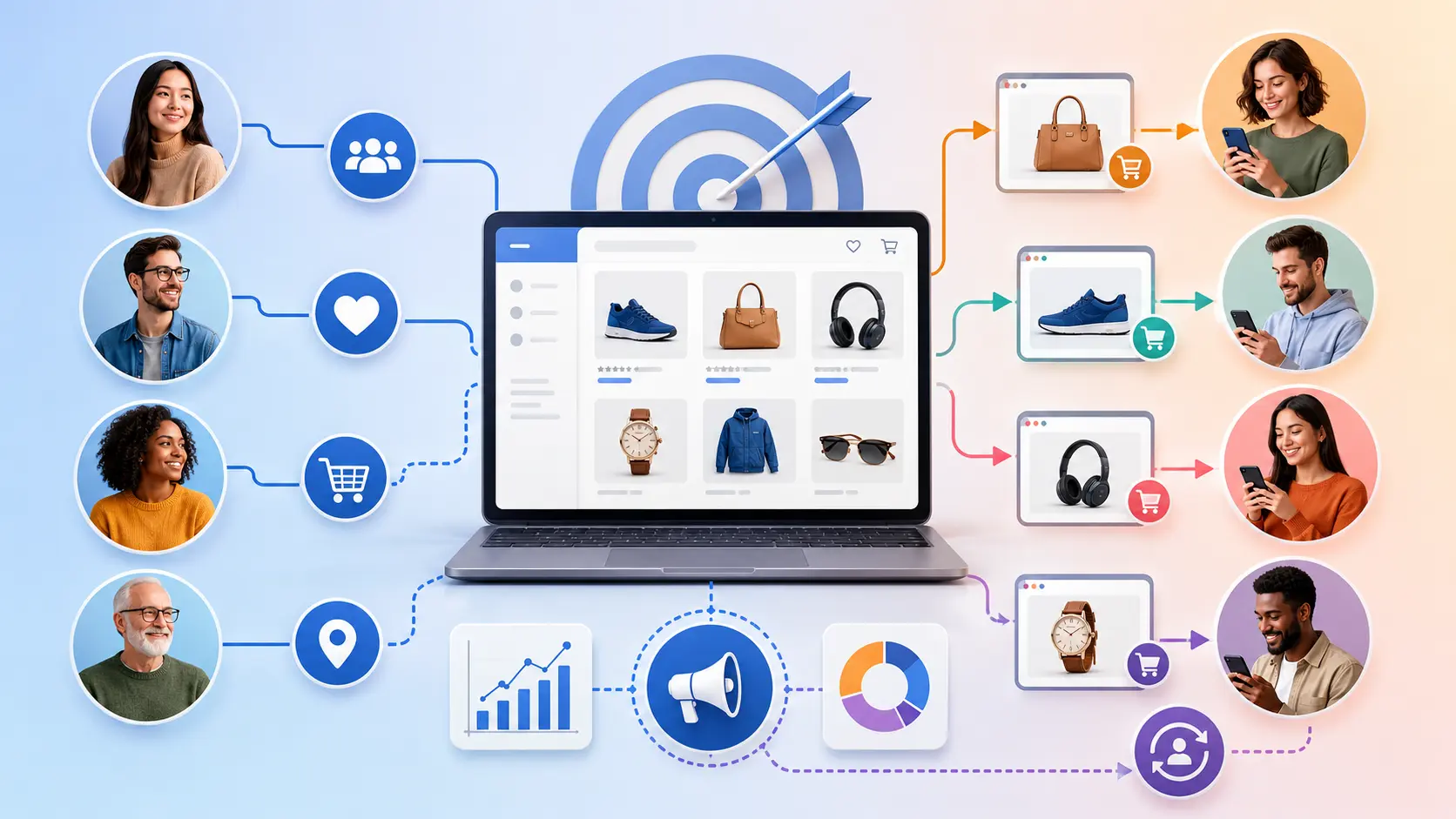
Launching an online store is not enough on its own. Even if your website has a convenient catalog, competitive prices, and good products, customers will not appear automatically. One way to attract potential buyers is targeted advertising.
Targeted advertising allows businesses to show ads not to everyone, but to specific groups of users — for example, people of a certain age, residents of a particular city, or users interested in specific product categories.
Let’s look at how targeted advertising works, how it differs from other types of promotion, and when it can be useful for an online store.
What Is Targeted Advertising?
Targeted advertising is advertising shown to an audience selected according to specific criteria.
The word “target” refers to the idea of focusing on a particular group of people.
Instead of showing the same ad to millions of random users, advertisers try to reach people who are more likely to be interested in the offer.
For example, an online store selling children’s products may show ads to users interested in parenting and products for children.
An automotive accessories store may target people interested in cars.
A local flower shop may show ads only to users located within a particular city or area.
The main idea is simple: show ads to people who are more likely to become customers.
Where Is Targeted Advertising Used?
Targeted advertising is most commonly associated with social networks and advertising platforms.
Ads can appear:
in social media feeds;
between posts;
in stories and short videos;
in recommendation sections;
across partner websites and apps;
as banners or product cards.
The exact options depend on the advertising platform.
However, the basic principle remains the same: the advertising system uses available information about users and selects an audience that matches the advertiser’s settings.
What Criteria Can Be Used to Select an Audience?
Targeting options vary depending on the platform, but several types of criteria are commonly used.
Location
Ads can be limited to a specific geographic area.
For example:
an entire country;
a particular region;
a city;
a district;
an area around a physical store.
This is especially important for businesses that only deliver within a limited area.
There is little value in advertising local flower delivery to users who live thousands of kilometers away.
Age
Some products are designed for a specific age group.
Advertising platforms may therefore use age as one of the factors when deciding who should see an ad.
Interests
Platforms may estimate user interests based on their online behavior.
For example:
cars;
home renovation;
electronics;
fashion;
sports;
travel;
home and garden products.
For an online store, this makes it possible to reach people who are already interested in a related topic.
Behavior
Modern advertising systems use not only basic characteristics, but also user actions.
For example, a user may have:
visited websites related to a certain topic;
viewed similar products;
interacted with advertising posts;
searched for specific product categories;
made purchases online.
Advertising algorithms use many such signals to estimate whether a person is likely to be interested in a particular offer.
Example of Targeted Advertising for an Online Store
Imagine an online store that sells table tennis equipment.
It could create several advertising campaigns.
One campaign could target people interested in table tennis.
Another could target users interested in sports equipment.
A third could target visitors who have already viewed table tennis rackets but did not complete a purchase.
A fourth could target previous customers who bought a racket and offer them balls, rubbers, cases, or other accessories.
This means one online store can work with several different audience segments at the same time.
Each group can receive a different advertising message.
What Is Retargeting?
Retargeting is a specific type of targeted advertising.
It allows businesses to reach users who have already interacted with their website.
For example, a person may:
visit an online store;
view a product;
add it to the cart;
leave the website without placing an order.
If the advertising platform can identify that user, the store may later show them an ad for the product they viewed or for the store itself.
This is especially important in e-commerce because not every visitor makes a purchase during their first visit.
Some people compare prices, read reviews, think about the purchase, or simply postpone the decision.
Retargeting allows the store to remind them about the product.
What Is the Difference Between Targeted Advertising and Search Advertising?
These two concepts are often confused.
Search or contextual advertising is usually based primarily on the user’s current search query or context.
For example, a person searches for:
buy 6205 bearing
They may then see ads from stores that sell this exact product.
In this case, the customer already has clear purchase intent.
Targeted advertising works differently.
The user may not be actively searching for anything at that moment, but the advertising platform may determine that they could be interested in a product.
For example, someone interested in cars may see an ad for automotive accessories while browsing social media.
This means the two advertising methods do not necessarily compete with each other.
An online store can use several acquisition channels at the same time:
SEO;
search advertising;
targeted advertising;
retargeting;
marketplaces;
social media;
email marketing.
Each channel solves a different problem.
Advantages of Targeted Advertising
Fast Traffic Acquisition
SEO takes time.
A new online store may need several months before it starts gaining strong search engine positions.
Advertising campaigns can be launched much faster and can begin generating traffic almost immediately.
Audience Selection
Instead of targeting everyone, businesses can work with specific groups of potential customers.
Testing Different Offers
For example, a store can create several ads:
one focused on price;
another focused on free delivery;
another focused on product range;
another promoting a specific product.
After enough data has been collected, the business can compare performance and keep the most effective options.
Measurable Results
With properly configured analytics, businesses can track:
impressions;
clicks;
cost per click;
add-to-cart events;
checkout starts;
completed orders;
customer acquisition cost;
revenue generated by advertising.
This is especially important for e-commerce.
The number of likes, views, or impressions alone does not tell you whether an advertising campaign is profitable.
Ultimately, an online store needs orders and profit.
Disadvantages of Targeted Advertising
Targeted advertising is not an automatic way to generate sales.
There are several important limitations.
Advertising Requires a Budget
Businesses usually pay for impressions, clicks, or conversions.
If the campaign is configured poorly, the budget can be spent without producing meaningful results.
Testing Is Necessary
It is often impossible to know in advance which audience or advertising message will perform best.
Businesses usually need to test several options and gradually disable the ones that do not work.
Good Advertising Cannot Fix a Bad Online Store
A user may click an ad, but what happens next depends on the website.
Sales may be lost because of:
slow page loading;
poor mobile usability;
complicated checkout;
limited payment methods;
unclear delivery conditions;
low-quality product photos;
weak product descriptions;
lack of trust.
For this reason, increasing the advertising budget does not always increase sales.
Sometimes the online store itself needs to be improved first.
What Happens After a User Clicks an Ad?
For e-commerce, this is one of the most important questions.
Imagine an online store pays to attract 1,000 visitors.
Out of those visitors:
800 leave the website quickly;
150 view several products;
40 add a product to the cart;
20 start checkout;
10 place an order.
The advertising campaign successfully brought visitors to the website, but the final result depended on the conversion rate of the online store.
That is why analyzing only the cost per click is not enough.
The entire customer journey should be measured:
advertising → product page → cart → checkout → payment → order.
If a large percentage of users leave at one particular stage, that stage may contain the real problem.
Where Should Advertising Traffic Be Sent?
One common mistake is sending every user to the homepage.
Imagine an ad that says:
Running shoes from $79
The user clicks the ad and lands on the homepage, where they see dozens of different product categories.
Now they have to search for the advertised shoes themselves.
A better option is to send them directly to:
the relevant category;
the advertised product page;
a dedicated landing page;
a promotional page.
The fewer unnecessary actions a user has to take, the more likely they are to continue toward a purchase.
Does an Online Store Need Analytics?
Yes.
Running advertising campaigns without analytics is usually a bad idea.
At a minimum, an online store should track:
product views;
add-to-cart events;
checkout starts;
completed orders.
It is also useful to send conversion information back to the advertising platform.
This makes it possible to evaluate not just visits, but actual customer actions.
Without analytics, an advertiser may see that a campaign generated 5,000 visits but have no idea how many of those visits resulted in sales.
Why Product Catalog Quality Matters
Modern advertising systems often work better when an online store has a properly structured product catalog.
Each product should ideally contain accurate:
product name;
price;
image;
availability;
category;
description;
specifications;
product page URL.
Some advertising platforms allow businesses to upload a product feed and automatically create ads from catalog data.
This is especially useful for stores with hundreds or thousands of products.
Instead of creating every product ad manually, the advertising platform can use data from the catalog.
How Much Does Targeted Advertising Cost?
There is no universal price.
The cost depends on many factors:
advertising platform;
competition;
industry;
location;
audience size;
ad quality;
seasonality;
bidding strategy;
competitor activity.
This means that cost per click alone does not tell the full story.
For example, one campaign may generate clicks for $0.30, while another generates clicks for $0.90.
At first glance, the first campaign looks more efficient.
But if only one out of 500 visitors from the first campaign buys something, while one out of 30 visitors from the second campaign makes a purchase, the more expensive click may actually be far more profitable.
For an online store, it is much more important to calculate customer acquisition cost and advertising profitability.
How Can You Tell Whether Advertising Is Profitable?
Here is a simple example.
An online store spends:
$5,000 on advertising.
The campaign generates:
250 orders.
The cost of acquiring one order is:
$5,000 / 250 = $20.
The next step is to compare that $20 with the economics of the store itself.
If the average profit per order is $50, the campaign may be profitable.
If the profit per order is only $10, the advertising strategy likely needs to be revised.
Repeat purchases should also be considered.
Sometimes the first order produces very little profit, but the customer returns and purchases several more times.
Who Can Benefit from Targeted Advertising?
Targeted advertising can work for many types of online stores, but it is particularly suitable for products that are visually appealing or easy to match with user interests.
Examples include:
fashion and footwear;
cosmetics;
home products;
furniture;
automotive products;
sports equipment;
electronics;
children’s products;
gifts;
hobby products.
For very narrow B2B categories or specialized industrial products, search advertising and SEO may sometimes work better because the buyer already knows the exact product name, model, or SKU they need.
However, the best channel always depends on the audience.
What Should an Online Store Prepare Before Launching Advertising?
Before increasing advertising spending, it is worth checking the website itself.
Pay particular attention to:
page loading speed;
mobile usability;
product pages;
product images;
prices and stock availability;
payment methods;
delivery information;
checkout process;
analytics setup;
cart functionality.
It is also useful to complete the entire purchasing process yourself from a smartphone — from opening the website to placing an order.
This often reveals problems that may be reducing advertising performance every day.
Focus on Sales, Not Just Traffic
Targeted advertising is only one tool for attracting customers.
It can bring new visitors, bring previous visitors back to the website, and help an online store reach new audiences.
But the final result depends on much more than advertising.
The entire system matters:
advertising → online store → catalog → product → cart → delivery → payment → repeat purchase.
Successful online store promotion is therefore rarely built around a single marketing channel.
SEO, search advertising, social media, product platforms, content marketing, and targeted advertising can all work together.
The goal for an online store owner is to understand which channels actually generate customers and how much each acquired order costs.
Targeted advertising allows businesses to show ads to selected audiences based on characteristics, interests, and behavior.
For an online store, it can be a useful way to attract potential customers more quickly, test different offers, and bring back users who have already visited the website.
However, advertising effectiveness should not be measured only by impressions or even by website visits.
The most important question for an online store is:
How many sales did the advertising generate, and how much did it cost to acquire those customers?
That is why targeted advertising works best when it is combined with proper analytics and a well-optimized online store.