
What Is a Product Recommendation System for an Online Store?
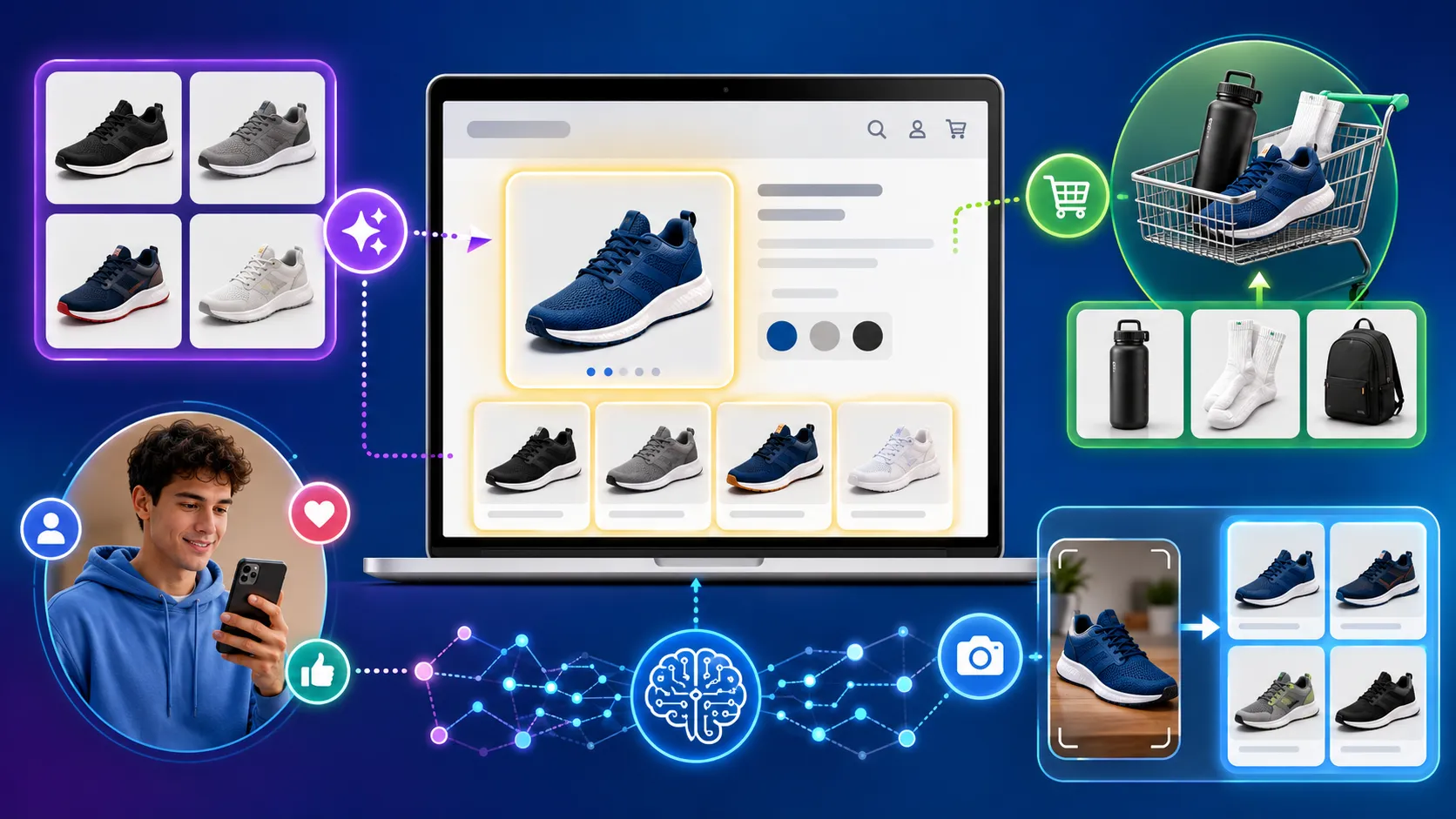
Customers rarely visit an online store with a perfectly defined request in mind.
Sometimes they know exactly what they need — for example, “a black 25-liter backpack.” But much more often, shopping works differently: a person opens one product page, looks at similar items, goes back to the category, changes filters, opens a few more options, and only then makes a decision.
The larger the product catalog, the more noticeable this problem becomes. It gets harder for customers to browse hundreds or thousands of products on their own and understand which ones are actually relevant to them.
This is where a product recommendation system comes in.
What Is a Product Recommendation System?
A product recommendation system is a mechanism that automatically selects products that may be relevant to a specific customer or related to the product they are currently viewing.
Most people are already familiar with common examples:
“Similar products”
“You may also like”
“Frequently bought together”
“Customers also viewed”
“Recommended for you”
At first glance, these may look like simple product blocks. But a good recommendation system works on a much deeper level.
It should understand what the customer is trying to find and which products are genuinely similar, rather than simply showing random items from the same category.
Why a Regular Product Catalog Is Not Always Enough
Imagine an online fashion store with 500 products.
A customer can open the “Jackets” category, choose a size, color, and price range, and narrow the selection down to 20 items. That is still manageable to browse manually.
Now imagine a store with 20,000 products.
Even well-designed categories and filters may no longer be enough. The customer has to constantly refine parameters, compare product pages, and go back and forth through the catalog.
It becomes even more difficult when the customer does not know the exact name of what they are looking for.
They may simply think:
“I want something similar to this bag.”
or:
“I like this dress, but I want something like it in another color.”
A traditional search bar is not very good at handling requests like these. A recommendation system can help the customer continue their search based on a product they already like.
How Product Recommendations Work
Recommendations can be generated in many different ways.
The simplest approach is to manually link related products.
For example, a store administrator can specify that a certain smartphone is compatible with a particular case, screen protector, and charger.
This works, but maintaining these relationships manually becomes difficult as the catalog grows.
That is why modern recommendation systems use data that already exists in the store.
They may take into account:
product categories;
product attributes;
manufacturer;
brand;
price;
color;
size;
description;
browsing history;
products added to the cart;
previous purchases;
product popularity;
the behavior of other customers.
The more useful signals the system can analyze, the more accurately it can select relevant products.
“Similar Products” Is Also a Recommendation System
One of the most useful applications is finding products similar to the one a customer is already viewing.
For example, someone opens a chair with a particular shape and color.
Instead of showing every chair from the same category, the store can suggest models with:
a similar design;
a comparable price;
similar materials;
suitable dimensions;
a similar color.
This can significantly shorten the customer's journey through the catalog.
They have already found something close to what they want. The store's job is now to help them explore alternatives instead of forcing them to start the search again.
How Recommendations Differ from Filters
Filters work according to rules chosen by the customer.
For example:
color — black, size — M, price — under $100.
A recommendation system works differently. It tries to determine which products are likely to be the most relevant automatically.
That is why filters and recommendations should not replace each other.
A good online store uses both:
filters help narrow down the catalog, while recommendations help customers explore it.
Recommendations Are Especially Useful for Visually Driven Products
There are many product categories where specifications do not tell the whole story.
For example:
clothing;
footwear;
furniture;
jewelry;
home decor;
bags;
accessories;
cosmetics;
household products.
A customer may like a particular shape, texture, color combination, or overall style.
These things can be difficult to describe with words.
That is why one of the next stages in recommendation technology is the analysis of product images themselves.
Searching for Similar Products by Image
Imagine this situation.
A customer sees a pair of sneakers they like somewhere online, saves the image, and wants to find similar models in a store.
Instead of trying to describe the sneakers in words, they upload the image.
The system analyzes the photo and finds visually similar products in the store's catalog.
The same approach can work directly from a product page.
If a customer likes a particular dress, the store can immediately show other models that are visually similar.
This creates a different way of searching.
The customer is no longer limited to keywords and product attributes. They can search using the image itself.
A Recommendation System Should Help, Not Distract
Sometimes recommendations are implemented simply because a store is expected to have them.
A large “You may also like” block appears on the product page, filled with almost random products.
It takes up space but does little to help the customer.
A good recommendation should answer a clear question.
For example:
Is there a similar option?
Is there a less expensive alternative?
What goes well with this product?
What else should I consider before buying?
Which products are most similar to this one?
If the system cannot reasonably explain why a certain item appears in a recommendation, the quality of those recommendations is usually low.
Where Recommendations Can Be Used in an Online Store
The product page is only one possible location.
A recommendation system can support customers throughout almost the entire shopping journey.
On the homepage, it can show relevant products based on previous browsing activity.
Inside a category, it can help surface the most suitable products from a large selection.
On a product page, it can suggest alternatives.
In the shopping cart, it can show products that genuinely complement the current order.
After a purchase, it can recommend items that may be useful later.
Even an unavailable product page does not have to become a dead end if the store immediately offers several close alternatives.
Does a Small Online Store Need a Recommendation System?
Not always.
If a store has 50 products and customers can easily browse the entire catalog, a sophisticated recommendation engine may not provide much additional value.
But the situation changes as the catalog grows.
With several thousand products, it becomes practically impossible to manually show every customer the most relevant part of the assortment.
At that point, the challenge is no longer simply how to add more products, but how to help customers find the right ones among the products that are already there.
That is exactly the problem recommendation systems are designed to solve.
The Next Stage of Search in Online Stores
For many years, online store search was built almost entirely around text.
The customer enters a product name, and the store looks for matching words.
Today, a more flexible model is gradually emerging:
text search → typo correction → attribute understanding → similar products → personalized recommendations → image search.
As a result, the catalog starts working as more than just a list of products. It becomes a navigation system for the entire assortment.
Customers can move more easily from a vague idea of what they want to a specific product.
What We Are Building at Ewonta
We are developing in this direction as well.
A full-featured recommendation system for online stores is currently being prepared as part of the Ewonta ecosystem. We plan to combine several technologies in one solution, including product recommendations, similar-product discovery, and product search by image.
The idea is not simply to add another standard “You may also like” block to an online store. The goal is to help customers genuinely navigate large product catalogs.
For example, a customer will be able to open a product they like and immediately see the closest alternatives, or upload an image and find visually similar products available in that specific online store.
We will share more details about these capabilities as the system continues to develop.
Recommendations Are First and Foremost About Navigation
Recommendation systems are often described primarily as a way to increase sales.
But their value is broader than that.
A large product catalog is not very useful if customers cannot navigate it effectively.
A good recommendation system should therefore reduce the distance between a customer and the product they are looking for.
Sometimes a well-designed similar-products block is enough.
Sometimes browsing history can help.
And sometimes it is easier to upload a photo than to explain to a search bar what exactly you are trying to find.
This is likely to become an increasingly important direction for search and navigation in online stores.