
How to Increase Repeat Purchases and Turn First-Time Buyers into Returning Customers
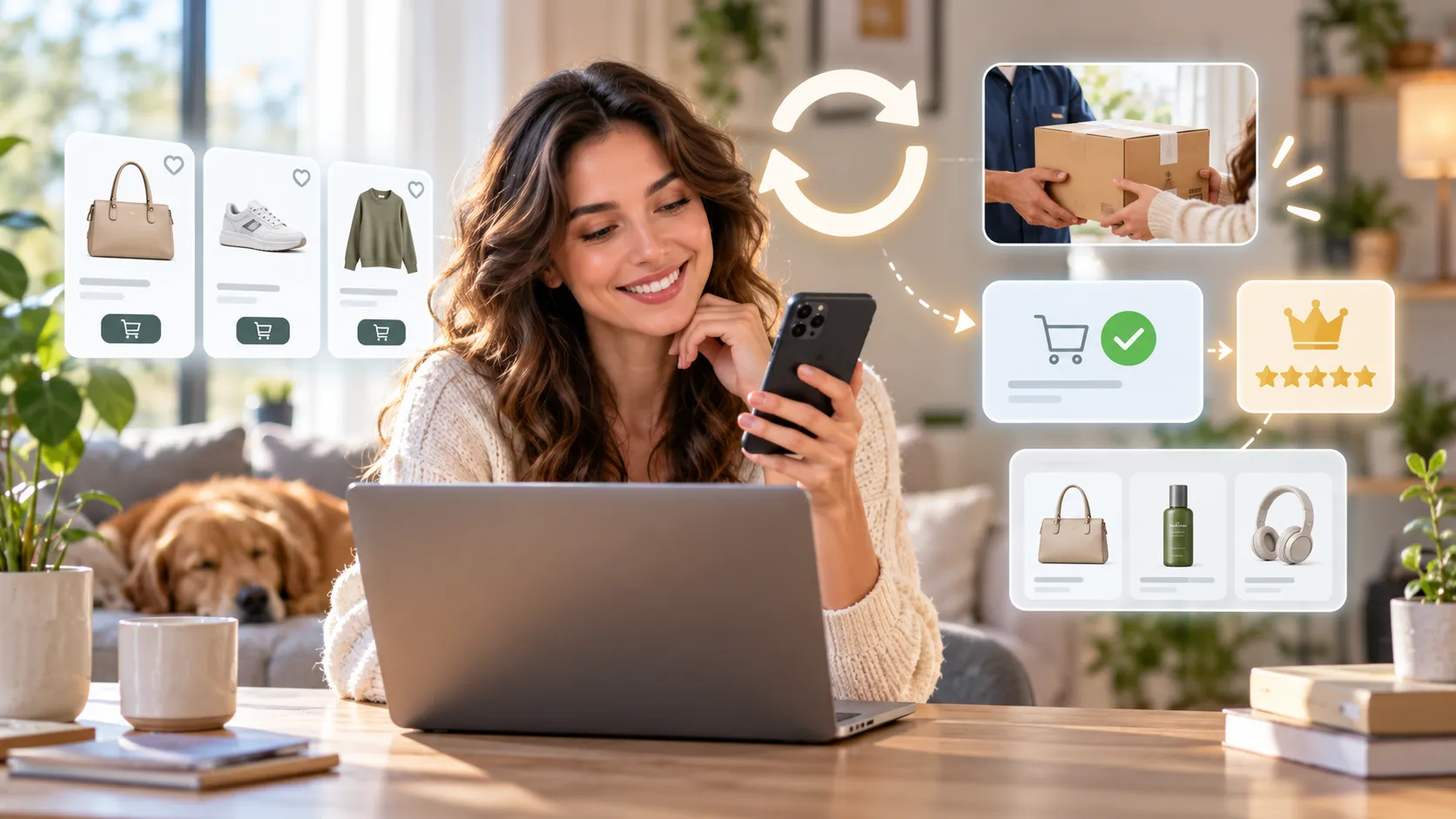
Getting the first order is difficult.
An online store has to attract the customer, help them find the right product, establish trust, offer suitable delivery and payment methods, guide them through checkout and successfully complete the transaction.
Then something strange often happens.
The order is shipped — and the customer is almost forgotten.
The next marketing budget is spent acquiring another new visitor.
Yet the store already has something much more valuable: a customer who knows the brand, has used the website, trusted the business with a payment and, if everything went well, received a product successfully.
That changes the question.
Instead of only asking:
“How can we acquire more customers?”
an online retailer should also ask:
“Why should an existing customer buy from us again?”
That question is becoming increasingly important in European e-commerce.
The first order does not create loyalty
A completed order does not automatically mean the customer has become loyal.
They may have discovered the store through Google, an advertisement, a marketplace, social media or a price comparison website.
Perhaps the product was simply available at the right price.
Once the order arrives, the customer may forget the retailer completely.
When the next need appears, they may return to Google, Amazon, Zalando or another marketplace and start the process again.
A second purchase requires another reason.
And that reason does not always need to be a discount.
Customers return because:
the previous order went well;
they trust the retailer;
delivery was reliable;
their details are already saved;
the product range is relevant;
ordering again is easier than searching elsewhere;
the store communicates useful information at the right moment.
Customer retention is therefore not a single marketing technique.
It is the result of the entire customer experience.
Why retention matters more as European e-commerce matures
Online shopping is already part of everyday life across Europe.
Eurostat reports that 78% of people in the EU purchased or ordered goods or services online in 2025.
In countries such as Ireland and the Netherlands, the share was above 90%.
That means many European markets are no longer in an early stage where growth comes simply from persuading more people to try online shopping.
Retailers increasingly compete for customers who already shop online frequently.
As markets mature, the focus naturally shifts from pure acquisition towards:
conversion;
retention;
customer lifetime value;
operational efficiency;
better use of first-party customer relationships.
A business that has to pay to reacquire the same customer every time is in a weaker position than one that can generate repeat orders through its own customer base.
1. Start with a good first order
No loyalty programme can repair a poor first experience.
If the parcel arrived late, support never responded, the product did not match its description or returning it became a complicated process, points and discount codes are unlikely to solve the problem.
Retention starts before the first purchase is completed.
Customers remember whether:
the product information was accurate;
the total price was clear;
delivery happened when promised;
tracking worked;
contacting the retailer was easy;
problems were handled fairly;
returns were understandable.
This is why customer retention should not be owned only by the marketing department.
Delivery, checkout, customer service, product data and post-purchase communication all affect whether somebody returns.
2. Make the second purchase easier than the first
Returning customers should not have to repeat every step.
If they already provided a delivery address, it can be stored securely in their account.
If they regularly buy the same products, previous orders should be easy to find.
Where the product category allows it, a Buy again or Repeat order function can remove several steps entirely.
This is particularly valuable for:
pet supplies;
cosmetics;
food and beverages;
contact lenses;
office supplies;
consumables;
professional equipment;
B2B purchasing.
Customers do not always want to browse.
Sometimes they simply want the same product again.
Convenience itself becomes a retention mechanism.
3. Use purchase history intelligently
Personalisation does not have to begin with a sophisticated AI system.
One of the most useful sources of customer context already exists inside the online store:
purchase history.
A customer who bought cat food probably does not need a generic campaign promoting dog food.
Someone who bought a printer may later need toner.
A customer who purchased a coffee machine may need coffee beans, filters or cleaning products.
Someone who ordered professional equipment may later need compatible consumables.
This moves communication away from:
“Here is our latest promotion.”
towards:
“Here is something relevant to what you already bought.”
That difference matters.
Recent UK consumer research published by Epsilon and RetailX found that 68% of respondents believe brands they regularly buy from already know what they want.
At the same time, 53% are frustrated when a retailer treats them like a completely new customer despite previous purchases.
The expectation is increasingly clear:
if a customer has already built a relationship with a retailer, the experience should reflect it.
4. Contact customers when the need is likely to return
Timing often matters more than the promotion itself.
A skincare product runs out.
A water filter needs replacing.
Pet food is consumed.
A professional supplier needs another box of consumables.
Contact lenses need replenishing.
If a retailer understands the approximate purchase cycle, communication can be based on likely customer need.
Instead of:
“We miss you — here is 10% off.”
the message can be:
“It has been around eight weeks since your previous order. Would you like to reorder?”
The second message has a reason to exist.
The first mainly benefits the retailer.
This is an important principle for retention marketing:
communication should ideally be triggered by customer context, not by the marketing calendar alone.
5. Keep loyalty programmes easy to understand
European loyalty programmes are becoming increasingly connected to personalised value rather than simple points collection.
Retailers are using combinations of:
member prices;
digital coupons;
cashback;
personalised rewards;
app-based offers;
early access;
delivery benefits.
But more features do not automatically create a better loyalty programme.
The value should be obvious.
For example:
Earn €5 credit after spending €100
is easier to understand than a system involving several point multipliers, membership tiers and exceptions.
Customers should quickly understand:
what they earn;
what it is worth;
how they can use it;
when it expires.
A loyalty programme should make purchasing feel more rewarding, not introduce another set of rules to learn.
6. Do not make discounts the only reason to return
Constant discounting can create the wrong behaviour.
If a customer learns that a 10% offer appears every few weeks, there is little reason to buy at full price.
Then comes 15%.
Then 20%.
Eventually the promotion becomes the expected price.
Repeat purchases can be encouraged through other forms of value:
free delivery;
priority access to new products;
exclusive products;
useful bundles;
loyalty credit;
additional service;
faster checkout;
personalised recommendations;
convenient repeat ordering.
Price is important.
But long-term retention should not depend entirely on reducing it.
7. Recommend products after the purchase
Product recommendations are not only useful before checkout.
They can also support the next purchase.
Examples include:
Compatible with your previous purchase
You may need these accessories
New products from a brand you purchased
Frequently reordered together
Refills for your product
The key is relevance.
Showing the same bestseller to every customer is not meaningful personalisation.
A useful recommendation should have a logical relationship with the previous purchase.
This is where product attributes, compatibility data and purchase history become valuable.
Good catalogue data improves not only search and filtering, but also customer retention.
8. Email still works when there is a real reason to open it
Email has not disappeared from e-commerce.
Poor email has simply become easier to ignore.
Messages such as:
“Sale now on.”
“New collection.”
“Last chance.”
become background noise when sent too frequently.
Triggered communication is usually more useful.
For example:
a product is back in stock;
the price of a saved product has changed;
a favourite brand has launched something new;
a replenishable item may need replacing;
loyalty credit has been added;
a previous order can be repeated;
a compatible accessory is available.
Each message has a clear reason.
That is more valuable than increasing campaign volume.
For European retailers, these communications also need to respect applicable privacy and electronic marketing requirements, including consent and customer communication preferences.
Retention should never mean ignoring customer control.
9. Use push notifications carefully
A mobile application gives a retailer something websites do not always have:
a direct place on the customer's device.
Push notifications can be extremely effective for:
order status;
back-in-stock alerts;
price changes;
loyalty rewards;
personalised offers;
reminders;
repeat orders.
They can also become irritating very quickly.
A push notification interrupts the user.
That means the threshold for usefulness should be higher than for many other channels.
A good test is simple:
Would the customer consider this information worth interrupting them for?
If the answer is no, it may belong in email, the app inbox or nowhere at all.
10. A mobile app does not make sense for every retailer
Launching an app should not be treated as a sign that a business has become large.
The more useful question is:
How often does a customer have a reason to return?
A store selling products purchased once every several years may struggle to justify an app.
The economics are very different for categories such as:
beauty;
fashion;
grocery;
flowers;
pet supplies;
specialist consumables;
frequently purchased B2B products.
In these categories, an app can shorten the path back to the store.
The customer already has:
an icon on the phone;
an active session;
saved addresses;
previous orders;
preferences.
Push notifications create an additional direct communication channel.
That is why a mobile app is most valuable when it improves an existing repeat-purchase pattern rather than trying to create one that does not naturally exist.
11. Do not treat every inactive customer in the same way
A customer has not ordered for three months.
Is that a problem?
It depends entirely on the category.
For pet food, three months may indicate churn.
For furniture, it may be completely normal.
This is why a universal automation such as:
“No purchase for 30 days → send discount”
is rarely a sophisticated retention strategy.
Even simple segmentation can improve this dramatically.
Customers might be grouped as:
first-time buyers;
regular buyers;
recently inactive customers;
promotion-driven buyers;
customers of a particular category;
high-value customers.
Then communication can reflect behaviour.
A frequent customer does not need a message saying:
“We haven't seen you for a while.”
And someone who made one small order six months ago probably should not be told they are one of the store's “most valued loyal customers”.
Good personalisation starts by avoiding obviously incorrect personalisation.
12. Measure more than total orders
If the goal is customer retention, total revenue alone does not explain enough.
Useful metrics include:
Repeat Purchase Rate
What percentage of customers place another order?
Customer Retention Rate
How many customers remain active over a defined period?
Customer Lifetime Value
How much revenue or contribution margin does the average customer generate over the relationship?
Time to second purchase
How long does it normally take for a first-time customer to order again?
Orders per customer
How does purchase frequency change over time?
New vs returning customer revenue
How much revenue comes from existing relationships rather than continuous acquisition?
The second purchase is particularly interesting.
There is an important behavioural difference between someone who has purchased once and someone who has chosen the same retailer twice.
The second order is often where a transaction begins to turn into a relationship.
First-party customer data is becoming more valuable
There is another reason retention is strategically important in Europe.
Retailers can no longer assume that third-party advertising signals will always provide an easy way to recognise and reacquire customers.
Consumers increasingly restrict tracking.
Browsers and platforms continue to change privacy mechanisms.
The 2026 RetailX/Epsilon study found that more than 65% of surveyed UK consumers limit or reject cookies.
At the same time, 71% agreed that being logged in or belonging to a loyalty programme leads to more relevant communication.
This creates an important distinction.
Customers may reject invisible tracking while still accepting useful personalisation within a relationship they understand.
That makes first-party relationships more important.
An account, purchase history, loyalty membership or app relationship can provide better customer context — provided the data is used transparently and responsibly.
Personalisation requires trust
European retailers need to be particularly careful here.
A customer may appreciate:
“You previously ordered this product — would you like to buy it again?”
The same customer may feel uncomfortable if personalisation appears to reveal information they did not expect the retailer to use.
Good personalisation should feel helpful, not invasive.
The principles are relatively simple:
explain what customer data is used for;
give customers meaningful choices;
respect marketing preferences;
avoid collecting information without a purpose;
secure the data;
do not turn every available data point into a marketing signal.
GDPR did not make useful customer relationships impossible.
It made transparency and purpose more important.
Do not send the same message to everyone
Retention automation often starts in the wrong order.
First, a business buys a marketing automation platform.
Then somebody asks:
What should we send?
The process should ideally work the other way around.
Start with the event.
For example:
Customer purchased a replenishable product.
A product may soon need replacing.
Customer has become inactive relative to their usual purchase cycle.
A saved product is back in stock.
A relevant new model has launched.
Loyalty credit is available.
A previously purchased item now has compatible accessories.
Then choose the appropriate communication channel:
email;
push notification;
SMS where appropriate;
in-app message;
website account;
personalised storefront.
Technology should support the customer journey.
The journey should not be invented simply because the technology supports it.
The online store has an advantage marketplaces cannot fully replicate
Marketplaces provide enormous reach.
They make discovery easier and give customers established logistics, payments and trust.
But the marketplace owns much of the customer environment.
An independent online store gives the business more control over its own customer relationship.
The retailer can build:
customer accounts;
purchase history;
loyalty;
direct communication;
personalised merchandising;
repeat-order flows;
customer service history.
This does not mean businesses must choose between marketplaces and their own store.
The channels can serve different purposes.
A marketplace can be an excellent acquisition channel.
An independent store can become the place where a long-term customer relationship develops.
Cross-border retention requires localisation
Retention becomes more complicated when an online store sells across Europe.
A German customer, Dutch customer and Italian customer should not necessarily receive the same experience.
Differences can include:
preferred payment methods;
delivery expectations;
parcel locker adoption;
language;
return behaviour;
local holidays;
marketing conventions.
Translation alone is not localisation.
For example, a repeat-purchase campaign that works well in one country may underperform elsewhere because the preferred delivery or payment experience is different.
Successful European retention therefore needs two layers:
one consistent customer strategy
and
local execution for individual markets.
How PrestaShop can support customer retention
PrestaShop already contains much of the underlying information required for a retention strategy:
customers;
accounts;
addresses;
orders;
products;
categories;
cart history;
discounts;
customer groups.
The challenge is turning this information into useful customer experiences.
For example, an online store can extend the platform with:
loyalty functionality;
repeat-order tools;
personalised recommendations;
mobile apps;
email automation;
customer segmentation;
external CRM integrations.
Because PrestaShop is an open e-commerce platform, businesses are not restricted to one fixed retention model.
The system can be adapted to the product category, customer lifecycle and countries where the retailer operates.
Where Ewonta fits
Ewonta treats the online store as more than a product catalogue and checkout.
A PrestaShop-based store can become the central commerce platform that connects:
website sales;
customer accounts;
order history;
product recommendations;
smart search;
mobile applications;
external integrations.
The Ewonta customer application can provide another direct channel for returning customers through saved access to the store and push notifications.
That does not mean every retailer needs an app.
The purpose is to make additional retention tools available where the business model genuinely benefits from them.
The broader principle is more important:
customer data and customer relationships should remain part of the retailer's own e-commerce infrastructure.
A retention strategy does not need to start with a complex CRM project
A useful first version can begin with only a few scenarios.
After the first order
Provide clear confirmation, delivery information and support access.
Do not immediately begin pushing another sale.
After delivery
Make it easy to report a problem, leave feedback or ask for support.
Before the likely next need
For replenishable products, send a relevant reminder.
When something useful changes
Notify the customer when a wanted product returns, a relevant new item appears or a useful benefit becomes available.
When a customer becomes genuinely inactive
Offer a reason to return that matches their previous behaviour.
These five scenarios are often more useful than dozens of generic campaigns.
Repeat purchases do not start with a loyalty card
Loyalty programmes, email automation, mobile apps, push notifications, recommendations and CRM systems are tools.
They do not create loyalty by themselves.
Customers return to retailers where the previous purchase went well and where the next purchase feels easier.
The foundation is surprisingly simple:
a good product;
clear pricing;
reliable delivery;
helpful support;
a remembered customer relationship;
easy repeat ordering;
a relevant offer at the right moment.
Automation can then make these experiences scalable.
That is the fundamental difference between customer retention and continuous acquisition.
A new customer must first be persuaded to trust the retailer.
A returning customer mainly needs a good reason not to start the search again somewhere else.