
Agentic Commerce in Europe: How AI Is Becoming a New Sales Channel for Online Stores
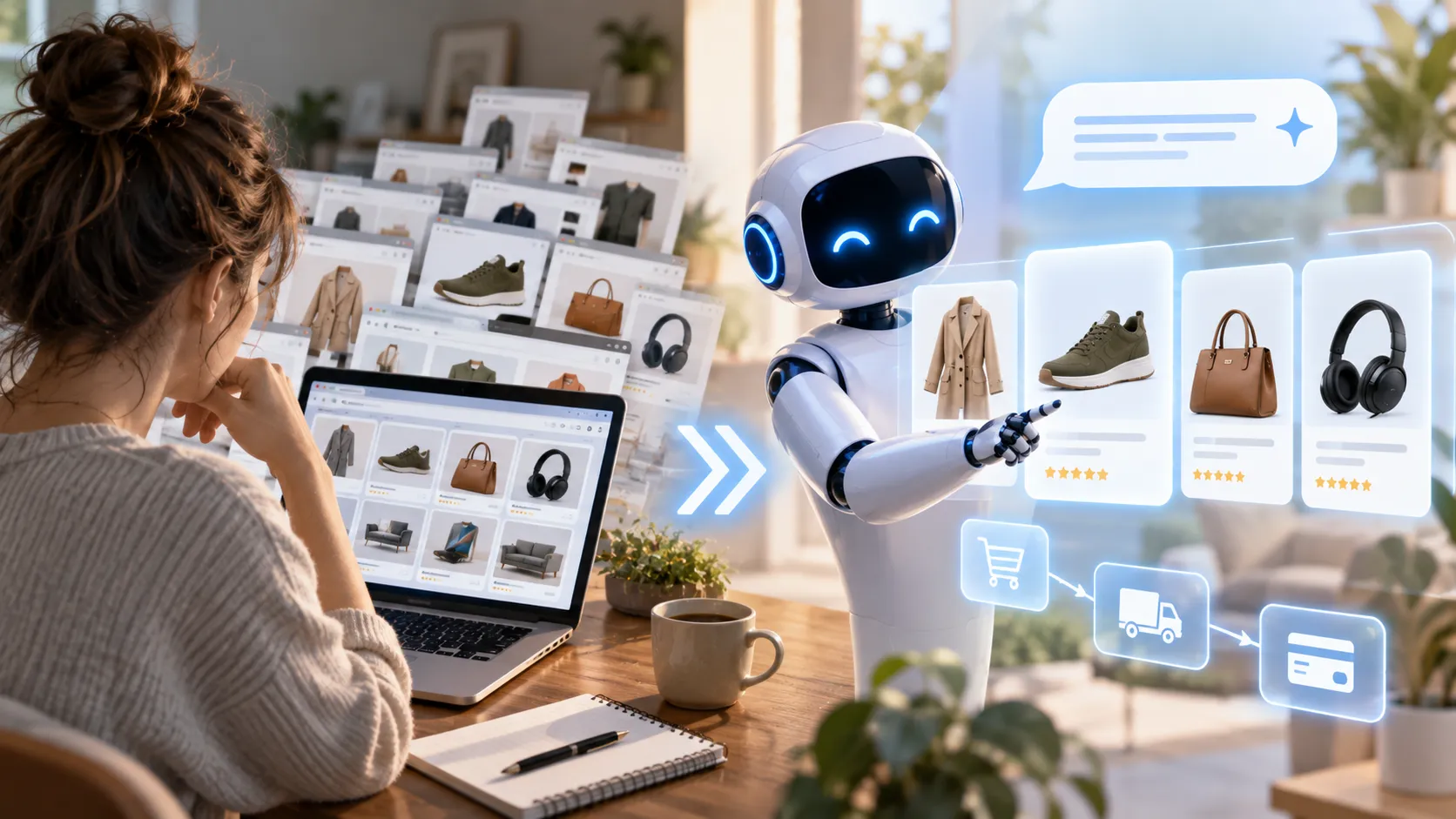
The way people shop online is starting to change.
For years, the typical buying journey followed a familiar pattern.
A customer opened Google, a marketplace or an online store, typed a search query, compared several products, opened multiple tabs and eventually made a purchase.
Artificial intelligence is beginning to change this sequence.
A shopper no longer needs to know the exact product name or even which store to visit.
They can simply describe a need:
“Find me a lightweight laptop for graphic design under €1,500.”
“Which running shoes are suitable for winter and wet weather?”
“Find a birthday gift for a seven-year-old under €60.”
An AI assistant can interpret the request, compare products and narrow down the options.
The next step is even more important.
Instead of only recommending products, AI systems are beginning to participate directly in the purchase process.
This new model is often called agentic commerce.
And in 2026, it is moving from an experiment to a real e-commerce channel.
What is agentic commerce?
Agentic commerce is a model in which AI agents help customers discover, compare and purchase products.
Traditional search engines mainly help users find websites.
AI agents can potentially go much further.
They can:
understand the shopper’s intent;
compare specifications;
apply budget constraints;
filter unsuitable products;
check availability;
compare delivery options;
recommend the best match;
and eventually participate in checkout.
The shopping journey becomes shorter.
Instead of:
search → results → several websites → comparison → product page → checkout
the journey can increasingly look like:
need → AI assistant → recommendation → purchase
This change may appear subtle, but for online retailers it has major consequences.
AI is becoming the new starting point for product discovery
One of the most important shifts is that customers may no longer begin their shopping journey on a retailer’s homepage.
They may start in ChatGPT, Google AI Mode, Gemini, Copilot or another AI interface.
That means online stores are no longer competing only for rankings in search engines.
They are also competing to be understood and recommended by AI systems.
This introduces a new question for retailers:
Can an AI agent clearly understand what your products are, who they are suitable for and whether they match the customer’s request?
For many online stores, the answer is still uncertain.
Why this matters specifically in Europe
European e-commerce is highly fragmented.
A retailer may sell in Germany, France, Spain, Italy, the Netherlands and several other markets at the same time.
Each market can involve different:
languages;
payment methods;
delivery companies;
VAT rules;
return expectations;
marketplaces;
shopping behaviour.
AI can potentially simplify product discovery across this complexity.
A customer may no longer need to understand which specialist retailer sells a particular item.
They can describe the requirement and let an AI system search across available offers.
For retailers, however, this increases the importance of structured and accurate product information.
AI cannot reliably recommend a product it cannot understand.
Agentic commerce is already becoming part of major platforms
The development of agentic commerce accelerated significantly in 2026.
Google introduced the Universal Commerce Protocol, an open standard designed to help AI systems and commerce platforms communicate.
The protocol was developed with Shopify and other major commerce companies.
At the same time, OpenAI expanded its own Agentic Commerce Protocol to support richer product discovery inside ChatGPT.
Shopify has also introduced Agentic Storefronts that allow eligible merchants to make their products available across AI channels such as ChatGPT, Google AI Mode, Gemini and Microsoft Copilot.
This is an important signal.
AI shopping is no longer simply a feature added to a chatbot.
Commerce infrastructure itself is starting to adapt to AI agents.
Product data is becoming part of marketing
For years, product data was often treated mainly as an operational issue.
A retailer needed:
a product name;
a price;
an image;
a short description;
perhaps a few specifications.
That was often considered enough.
Agentic commerce changes the situation.
Imagine that a customer asks:
“Find me a dining table for six people, less than 180 cm wide, made from solid wood and available for delivery next week.”
An AI system needs to identify products that actually match those conditions.
A marketing description such as:
“Beautiful premium table for a stylish modern home”
is almost useless for this task.
Structured information is far more valuable:
width: 175 cm;
material: solid oak;
seating capacity: 6;
colour: natural;
stock status: available;
delivery: 3–5 business days.
The better the data, the easier it becomes for AI systems to understand the product.
This makes product information an increasingly important part of customer acquisition.
Clean catalogues will matter more than ever
Large e-commerce catalogues often contain inconsistent data.
One supplier may send:
Colour
Another:
Product colour
Another:
Primary colour
And another may provide a field called:
color_name
A human immediately understands that these values are related.
Software systems may not.
The same problem appears with units.
For example:
10 cm;
100 mm;
0.1 m.
These values describe the same measurement, but not in the same format.
When catalogues contain thousands of products from multiple suppliers, inconsistent data becomes a serious problem.
AI shopping makes this issue even more visible.
Before retailers think about advanced AI integrations, they may need to solve a much less glamorous problem:
catalogue normalisation.
AI readiness is not the same as adding a chatbot
Many businesses still associate AI in e-commerce with customer support chatbots.
That is only one small part of the picture.
A store can have an excellent chatbot and still be poorly prepared for agentic commerce.
Real AI readiness involves the underlying commerce infrastructure.
That includes:
product data;
structured attributes;
prices;
inventory;
variants;
delivery information;
APIs;
checkout;
payment systems;
order management.
An AI agent is only useful if it can access reliable information.
If the product price is outdated, stock information is inaccurate or product variants are unclear, AI cannot fix the underlying data problem.
What happens to traditional SEO?
SEO is not disappearing.
But product discovery is becoming broader.
Traditional SEO focuses on helping a search engine understand and rank a page.
That still matters.
Retailers still need:
indexable pages;
good site architecture;
descriptive titles;
internal linking;
useful content;
fast loading;
structured data.
But AI adds another requirement.
The system must not only understand the page.
It must understand the product itself.
For e-commerce, this means the boundary between SEO, catalogue management and technical infrastructure is becoming increasingly blurred.
Product attributes that once looked like back-office details may directly influence whether a product appears in an AI recommendation.
Structured data becomes even more important
Schema.org product markup has been useful for search engines for years.
It helps describe:
product names;
brands;
offers;
prices;
availability;
ratings;
identifiers.
In an AI-driven shopping environment, structured data becomes even more valuable.
It gives machines a predictable way to interpret commercial information.
This does not mean Schema.org alone will make a store ready for AI agents.
But it is part of the foundation.
Retailers should increasingly think in terms of multiple layers:
human-readable content
search-engine-readable structure
machine-readable commerce data
The strongest e-commerce platforms will need all three.
Where does llms.txt fit?
Another topic frequently discussed in AI search is llms.txt.
The idea is to provide AI systems with a simplified overview of a website and its important content.
This can be useful for documentation, company information, guides and editorial content.
However, llms.txt should not be treated as a replacement for proper product infrastructure.
An AI shopping agent needs live commercial information.
It may need to know:
whether a product is available;
its current price;
which sizes are in stock;
where it can be delivered;
how long delivery takes.
A static text file cannot reliably provide all of that.
The real foundation remains structured catalogue data and reliable integrations.
How this affects PrestaShop stores
This shift is particularly interesting for stores built on PrestaShop.
PrestaShop already stores most of the information required by modern commerce channels:
products;
categories;
attributes;
features;
combinations;
brands;
prices;
stock;
images;
customers;
addresses;
orders.
That means the fundamental data already exists.
The challenge is making it consistent and accessible.
For example, a PrestaShop store may have the same product characteristic represented in several different ways because the catalogue was imported from multiple suppliers.
The information exists, but it is not necessarily clean enough for external systems.
This is why catalogue normalisation, clean APIs and structured integrations are likely to become increasingly important for PrestaShop merchants.
The online store is becoming a commerce engine
A useful way to understand this shift is to stop thinking about an online store as simply a website.
A modern retailer may sell through:
its own website;
a mobile application;
Amazon;
Zalando;
eBay;
Google;
social commerce;
shopping comparison engines;
AI assistants.
The customer may interact with the same catalogue through many different interfaces.
This means the website is no longer the entire commerce system.
The underlying platform becomes the central source of truth.
It holds:
products;
prices;
stock;
orders;
customer data;
fulfilment logic.
External channels consume those data and send orders back.
In this architecture, the online store becomes a commerce engine, rather than merely a storefront.
Why platform ownership matters
The rise of AI commerce also creates a strategic question.
Who controls the underlying commerce infrastructure?
If a business depends entirely on external platforms, each new sales channel may require another separate integration or another third-party service.
An open e-commerce platform offers a different model.
The business retains control over its catalogue, data and integrations.
New channels can be connected as they become relevant.
This is particularly important because no one can predict exactly which AI shopping interfaces will dominate in three or five years.
Flexibility becomes more valuable than trying to predict a single winner.
What retailers should check now
There is no need to rebuild an entire e-commerce platform because of agentic commerce.
But there are several things worth reviewing today.
Product names
Product names should clearly describe what is being sold.
Internal codes alone are not enough.
Attributes
Important specifications should be stored in structured fields rather than hidden inside long descriptions.
Variants
Colours, sizes and other variants should be represented consistently.
Inventory
Stock levels should be reliable and updated frequently.
Pricing
External systems need a clear source of current pricing.
Product identifiers
GTIN, EAN, manufacturer references and other identifiers should be stored correctly where available.
Images
High-quality product images are increasingly important because AI systems are becoming multimodal.
APIs
The commerce platform should be capable of exchanging information with external systems without requiring a complete redesign.
Multilingual commerce creates another challenge
Europe adds another layer of complexity: language.
A product may have descriptions in English, German, French, Spanish and Italian.
But attributes must still represent the same underlying concept.
For example:
Colour
Farbe
Couleur
Colore
The labels change.
The meaning does not.
A well-designed catalogue should separate the semantic meaning of a characteristic from its translated presentation.
This can make future AI integrations significantly easier.
Payments will also change
AI discovery is only the beginning.
The larger transformation happens when agents begin completing transactions.
This requires payment systems to determine:
whether an AI agent is authorised;
who approved the transaction;
how fraud is handled;
how consent is recorded;
how the merchant verifies the agent.
In September 2026, Visa, Mastercard and Ant International announced work on a common trust framework for AI agents making purchases.
This shows that agentic commerce is beginning to reach the payment layer as well.
The question is moving from:
“Can AI recommend a product?”
to:
“Can AI safely complete the transaction?”
European regulation cannot be ignored
Europe is also different because AI commerce develops within a strong regulatory environment.
Retailers need to consider areas such as:
GDPR;
consumer protection;
payment regulation;
AI-related obligations;
transparent pricing;
returns;
consent.
AI does not remove these responsibilities.
If anything, automated transactions make transparency and data governance more important.
Retailers should therefore avoid treating agentic commerce as only a technical integration.
Legal and operational processes will need to evolve alongside the technology.
Will AI replace marketplaces?
Probably not.
Marketplaces provide far more than product discovery.
They offer:
large audiences;
fulfilment;
payments;
trust;
customer service;
loyalty programmes.
AI agents are more likely to change how customers decide where to buy.
Instead of opening a marketplace first, a customer may ask an AI assistant:
“Find the best option for me.”
The assistant may then compare offers from multiple sources.
This creates both a threat and an opportunity for independent retailers.
The threat is obvious: another intermediary appears between the brand and the customer.
But the opportunity is equally important.
A specialised independent retailer may become discoverable without the shopper already knowing the brand.
AI changes both sides of e-commerce
Artificial intelligence affects online stores in two directions.
Outside the store, AI agents help customers discover products.
Inside the store, AI can help retailers organise their own data.
For example, AI can assist with:
product classification;
duplicate detection;
attribute normalisation;
product descriptions;
visual search;
similar-product recommendations;
catalogue enrichment.
These two trends reinforce each other.
The better organised the catalogue is internally, the easier it becomes for external AI systems to understand it.
The real asset is not just the website
For many years, businesses treated their website as the core digital asset.
Agentic commerce reveals something deeper.
The real asset is increasingly the commerce data behind the website.
Products.
Attributes.
Prices.
Stock.
Images.
Relationships between products.
Orders.
Customer information.
If these data are structured and controlled by the business, they can power many different interfaces.
A website today.
A mobile application tomorrow.
A marketplace integration next month.
An AI shopping agent after that.
The interface changes.
The underlying data remains.
Where Ewonta fits
Ewonta is built around this idea.
A store should not be a closed website that needs to be replaced every time a new sales channel appears.
It should be an independent e-commerce platform that can evolve.
Ewonta stores are based on PrestaShop and can be extended with additional integrations, mobile applications, smart search, product recommendations and other commerce tools.
The goal is not to install every possible technology immediately.
The goal is to create an infrastructure that can adapt when a new channel becomes commercially relevant.
Agentic commerce makes this flexibility increasingly important.
What happens next
It is still too early to know exactly how much European online shopping will eventually be handled by autonomous agents.
Consumers currently use AI primarily for product discovery, comparison and decision support.
But the infrastructure for transactions is developing quickly.
Google, OpenAI, Shopify, payment networks and other major companies are already building the standards required for AI-assisted commerce.
The direction is becoming clear.
AI is moving from answering shopping questions to becoming part of the commerce infrastructure itself.
For online retailers, the practical question is therefore not:
“Will AI replace traditional online shopping?”
A much more useful question is:
“If an AI agent is looking for the exact product my customer needs, will it understand my catalogue well enough to recommend it?”
That is where preparation for agentic commerce really begins.